Showing posts with label dress. Show all posts

Saturday, June 1, 2013

Thrifty Finds

I'm a huge fan of thrift stores and flea markets, and so I thought it would be fun to share some of my recent finds with you.

Cobalt and gold tea cups (Imperial Lomonosov Porcelain Factory) from Frida Marina 

I already had a Lomonosov cobalt teapot, and so when I saw these pretty cups, I just new I had to get them for a set. Now all I need is a sugar bowl.  


 Fresh Spirit by Ellos dress from UFF

I really love the pattern on this cotton tunic dress. It has large yellow roses and smaller pink flowers on a green background. The cotton is very thin, so it will be perfect for hot summer days.

Belt from UFF

I got this brown studded belt on sale for just 1 Euro  It needed a little fix-up, but nothing some leather glue couldn't mend. It also doubles as a really cool bracelet.


Tirol dirndl from UFF

I saved the best for last. I got this dark pink Tirol dirndl for 3 Euros. I already have two Tirol skirts, one dress and a woolen vest. They're all handmade and the quality of fabric and stitching is very good. The dress has a cute pattern made up of red and blue lines with little light pink 'flowers' in the middle of each square. I'm loving its faux 19th century peasant look.   

Friday, February 15, 2013

Dress of the Week: Striped Taffeta Day Dress

Oh, how I long for something bold and whimsical to wear during the day! Fortunately, this striped taffeta day dress is perfect for it.  

Day dress, 1820. Source: The Kyoto Costume Institute

Date: 1820
Country: Unknown
Medium: Silk taffeta
The early 19th century was a blur of white muslin imitating Ancient Greek statues and the classical silhouette, but by 1812 color and trimming were coming back in vogue. Gothic, Tudor and Elizabethan elements were making their mark on day and evening fashions. The waists were still high, but the skirts were getting wider and decorations on the hem and bodice were abundant.        

With this lovely brown and blue striped silk taffeta gown the Gothic influences can be seen in puffy sleeves and the cording and puff decorations on the bodice as well as the flounces along the hem of the skirt. Despite its very bold choice of colors (blue and brown stripes) and silk taffeta fabric, it is not an evening gown. It is a day dress, which means that it was an appropriate outfit for informal occasions before dinnertime. It could be worn around the house or while visiting close friends and neighbours. 

Sunday, February 10, 2013

How Many Dresses Does a Regency Lady Need?

We all aspire to be fashionable Regency ladies, do we not? But how does one accomplish such a task?

First, you must consider your wardrobe. Do you have enough gowns? Are they elegant or vulgar? Whatever shall you wear on your trip to Bath? All important questions, which I will attempt to help you answer.

Let's start from the basics.

Underwear
Unless you are a very fast lady, drawers are a no-no. Start with a shift, a long sack-like gown worn underneath all your other clothes. Linen is best - it is light and easy to wash. Gone are the days of the conical stays that your grandmother wore with such pride. Your stays are longer to flatten out the stomach and smooth out the silhouette.  Last comes your petticoat. Stocking are essential. Wool for winter and cotton for summer. And go glam with silk for a ball.

Stays, 1819, Source: Jane Austen Centre 
Morning Dress
Between the hours of rising and sitting down to dinner, you may wear a morning dress. It is a simple, practical gown made of muslin, calico or wool. Your arms, neck and bosom must be covered. But just because this is your at-home dress does not mean it should be shabby. Remember, lace can make any gown elegant. But all in moderation, you do not want to appear vulgar.  

Morning dress, France, 1818-1820. Source:  Les Arts Décoratifs

Day Dress / Afternoon Dress
For at-home visits and family time change into a day dress. But remember, modesty is everything. The French may suffer to wear deep decolletes, but as a proper English lady you better cover it up. Chemisette or fichu should do the trick.
   
Dress (open robe), 1795. Source: Met Museum  

Walking Dress / Promenade Dress
When out shopping or making formal calls, wear a walking dress. And out in a public place, go for a promenade dress. The two are often considered to be the same, but a promenade dress is usually a little more fine. Fabrics are light in the summer and heavier in the winter. Choose appropriate outwear for the season: shawl or warp for warmer weather, a spencer or pelisse for a colder day. You don't want to catch 'the muslin disease'.

Pelisse-coat, 1823. Source: Museum of London

Evening dress
Dinners at home or abroad are grand occasions. And you must show off all your finery. The neckline is lower and you may bare your arms. However, watch the fashion magazines. Sometimes long sleeves are in vogue, at others, short ones are popular. Fabrics can be rich: silk and satin. And if you are sick and tired of the dull 'classical' style, go for more recent history as Medieval, Renaissance and Gothic elements are very 'in' for both morning and evening wear.      

Evening Dress, 1823, Ackerman's Repository

Ball Dress
Some ladies are content with one fine evening gown for balls and dinners, but you should consider having a ball gown made especially. Fabrics are light, as you will be dancing, but rich. Popular choices are fine muslin, silk satin, duchesse silk and light taffeta. For a risqué look go with velvet. You may show your bosom, it is all right. A débutante ought to wear white and light pastels; married or older women may go with darker shades. To truly stand out in the candlelight adorn your dress with metallic trims, nets and beads. Gloves are a must for dancing and a fanciful turban will show your excellent taste.

Ball dress, 1812, Ackerman's Repository

Ridding Habit
A lady must ride; if only to accompany her husband. The dress for this activity is naturally darker, sturdier and heavier than your other gowns. Male fashions are de regulier with many masculine and military elements. The skirt is fuller than on a regular dress - you do not wish to show the world more than they ought to see.  

Ridding habit, 1817, Ackerman's Repository

Mourning Dress
When that disagreeable relation with a very large estate falls ill, start preparing a mourning dress. Black is for full mourning. For half mourning you may wear lilac, purple, grey or lavender. Avoid any shiny fabrics or jewellery. During half mourning a few black trinkets are acceptable.  

Mourning dress, 1823-1825. Source: Victoria & Albert Museum

Thus concludes our look at a wardrobe of a fashionable lady. Of course, one must not forget the dresses you will need for seaside resorts or evenings at the opera and numerous lovely accessories that a lady of quality simply must have at hand to be truly elegant. But that is a post for another day.    

Sunday, November 11, 2012

Jewel Beetles in 19th Century Fashion

Evening Dress, 1850, India? Source: The Kyoto Costume Institute
What a beautiful dress! Mid-19th century white mull with silk satin bodice, a floral pattern and a matching shawl. So elegant!

But look closer. Can you see it? The floral embroidery on the skirt and shawl is made of thousands of beetle wings!

Evening Dress, detail, 1850, India? Source: The Kyoto Costume Institute
Jewel beetles or buprestidae have iridescent blue-green elytra (the hard case covering the wings) that reflect light very much like sequins and have been traditionally used for beetle wing jewelry and decorations. The elytra are lightweight and very durable. They retain color for a very long time and often remain intact when the surrounding fabric has practically disappeared.  

Jewel beetle embroidery came to England from India, where Madras and Clacutta were the centers of beetle wing art. The exquisitely beautiful elytra had been used since the beginning of the Mughal Empire to decorate turbans, wedding dresses and ceremonial robes as well as for jewelry and even paintings.

Dress piece, muslin, Madras (Chennai), India, about 1880. Source: V&A Museum
Though the technique came from India, Europeans often used the wing cases of South American jewel beetles. They must have looked quite dazzling in candlelight. This style of embroidery was not only fashionable, it was also considered a suitable pastime for ladies of leisure, who were advised to use Walker's number 8 needle and green thread.

Once the vogue for beetle wings on ball gowns had passed, they were often altered for fancy dress parties and masquerades. Beetle wings also found a home on the stage. Probably one of the most famous instance of jewel beetles in fashion is the stunning green dress worn by Ellen Terry in the role of Lady Macbeth at the London Lyceum Theater in 1888.

Ellen Terry as Lady Macbeth by John Singer Sargent, 1888
Ellen Terry's Lady Macbeth dress © Zenzie Tinker Conservation Ltd
The gorgeous emerald and sea green gown is crocheted and composed of 1,000 jewel beetle wings. It has recently been restored and it took artists 1,300 hours to return the tattered dress to its former glory. It is currently on display at Smallhythe Place.

While using bugs for decoration may seem like a strange Victorian caprice, some modern designers still use jewel beetles for dresses and jewelry.

Take for instance the young designer Holly Russell who created this sheer fantasy in 2009.

The Blue Jewel Beetle dress by Holly Russell, 2009
The dress is from Russell's Animals & Minerals collection and uses jewel beetle wing cases and human hair to create that slightly surreal effect.

And if you have seen the recent Snow White and the Huntsman (2012), you may recognize this gorgeous gown worn by Queen Ravenna.
Evil Queen dress by Colleen Atwood, 2012 
The dress was designed for Charlize Theron's Evil Queen by Colleen Atwood. It is made of turquoise and gold chiffon with jewel beetle detailing.

Jewel beetle embroidery is truly beautiful and it is a shame that it has been relegated to the world of high fashion and film costumes. I suppose people are just too squeamish about wearing insects; but maybe we should consider adding some nature's own iridescence to our everyday style.    

Monday, October 15, 2012

Shakespeare Inspired Halloween Costumes

If you've run out of great Halloween costume ideas, you can always turn to classical literature for inspiration.And no one has created more colorful and memorable characters than William Shakespeare. You don't have to go full-on Elizabethan with this. Shakespearean theater was highly anachronistic, and Athenian nobles, fairies and Italian lovers all dressed in contemporary English fashions, though they were always very theatrical.

Here are just a few of my own ideas of how to make great Shakespeare-inspired Halloween.

Lady Macbeth
Probably the easiest costumes to make. All you need is a gown and a dagger, but if you want to go with something a little more recognizable I recommend Ellen Terry's green dress.

Lady Macbeth

You will need:
- Green floor-length gown
- Golden metal belt
- Crown
- Dagger
- Long red wig

The character is very dark, so dramatic eyeliner and red lips are in order. Some fake blood on your hands and a dagger, complete the look.

Ophelia
This is a great costume if you have a limited budget and no time. The character is very recognizable, but to make it easier for your fellow party goers to figure it out use a painting as inspiration. Pre-Raphaelites have created some of the most famous Ophelias in art.

Ophelia

You will need:
- White floor-length gown (check out thrift stores for some wedding dresses)
- Wreath of flowers for your head
- Garlands of flowers to hold

Ophelia drowned, so go for pale makeup with hints of blue. Using a slightly blue lipstick will give you that ephemeral look. Go barefoot or wear soft slippers. Hair doesn't need to be neatly done, and even if you have a shortcut, you can probably get away with it and avoid the wig.

Cleopatra
This Lady of the Nile has always been a Halloween classic. And Shakespeare's Cleopatra doesn't have to be very different from any other. You can use a store-bought costume or put something together yourself.

Cleopatra

You will need:
- White Grecian-style gown
- Leopard-printed shawl
- Lots and lots of gold and turquoise jewelry
- Toy snake    

Remember, Cleo is all about the hair and the eyes. No need to be subtle here. There's some great makeup tutorials online. And don't forget to take a toy snake to add some drama to the costume.  

Viola-Cesario
What could be more fun than a costume of a girl pretending to be a boy?  You can go full-Elizabethan here, but if that's too much for your budget, you could always put together something a little more stylized.

Viola / Cesario

You will need:
- White flouncy shirt with puffy sleeves
- Dark tight pants
- High boots
- A vest (look for one that has a slightly military look)

To finish the look, make sure you have a short haircut. If you have long hair and don't want to lose it for the sake of a Halloween costume, just hide it under a cap.  

Zombie Romeo and Juliet
Romeo & Juliet is a great costume for a couple, but it's been done to death. Unless, you make your star-crossed lovers into a couple of zombies. Nothing says "Halloween is here, baby", like a pair of famous dead lovers.

Romeo & Juliet

You will need:
- Medieval/Renaissance costumes (local costume store) Extra points if they match
- Vile of poison
- Toy sword

This one is all about the makeup. Check out some videos on how to create a zombie look. If your costumes aren't too expensive give them a tattered look. Your Romeo will need to have a greenish or bluish tint to his skin, especially around the mouth, to give him a poisoned look. Get some fake blood over the chest and don't forget the bloodied sword for Juliet.

Do you have some great Shakespeare inspired costume ideas? Please share!  

Friday, October 12, 2012

Dress of the Week: Bat Fancy Dress

While masked balls were somewhat stigmatized during the Georgian era, by the time Victorians came about, fancy dress balls were all the rage. And fashion publications of the time had plenty of creative and sometimes bizarre costume ideas. And since I love Batman this Victorian Bat fancy dress is especially appealing to me.

Bat costume, La mode illustrée, Journal de la famille, 1887

Bat fancy dress based on 1887 fashion plate

This whimsical costume consists of a flounced skirt with crinoline, polonaise, corset bodice, opera gloves and a fichu with a cape shaped like bat wings attached. Two little bats perch on the shoes and a slightly larger bat is spread over the bosom. Add a cute bat-hat and the costume is complete. For me it's the hat that makes this costume absolutely worth the effort. And who can resist coming to a Halloween party dressed as a Victorian Batgirl?

The best part, you can actually buy a pattern for this outfit! Unfortunately  the bat-hat is not included. And Sewing to Distraction actually recreated this look last year. Check out her step-by-step journey into Victorian fancy dress.     

Friday, October 5, 2012

Dress of the Week: Electric Light Fancy Dress

Since it's October, also known as Halloween month, my Dress of the Week posts will be about great fancy dresses of yore. First up is this electrifying, pardon the pun, gown from the House of Worth.

Fancy Dress, 1883, House of Worth. Source: MCNY   

Fancy Dress, bodice, 1883, House of Worth. Source: MCNY

Fancy Dress, bodice detail, 1883, House of Worth. Source: MCNY

Fancy Dress, bodice lining 1883, House of Worth. Source: MCNY
Date: 1883
Material: Yellow satin; golden yellow satin; metallic thread embroidery; paillettes and beads; midnight blue velvet; yellow tulle with applied tinsel; tinsel and looped cord edging; glass pearls; fringe 
The "Electric Light" is a really gorgeous gown created by Maison Worth for Mrs Cornelius Vanderbilt II that she worn to the Vanderbilt Ball on March 26, 1883. Despite being just a fancy dress, the amount of work that went into it and the intricacy of detail is amazing. It is yellow and golden yellow satin with a midnight blue velvet underskirt and yellow tulle drapery falling from the shoulders. The dress is covered with gold and metallic tinsel and embroidery with clear and gold beads arranged in lightning bolt and starburst shapes. 

This gown definitely does not lack embellishment with metallic tinsel, cords, glass pearls, gold beads and copious amounts of fringe. The skirt has a very pronounced bustle, with the overskirt gathered at the center and open at the back to show off the lovely embroidery on the underskirt and train.

Mrs Vanderbilt as Electric Light, 1883 
The dress does look absolutely stunning and must have made quite an impression when Mrs Vanderbilt graced the ball with her presence. The idea of dressing up as a common utility may seem a little strange to us  modern folk, but it was still quite novel to the people in the late 1800's. Electricity as a fancy dress seemed to have been rather popular in Victorian times. 

Friday, September 28, 2012

Dress of the Week: Court Dress

It is Friday night and I'm all dressed up and nowhere to go. And nothing says 'party' quite like an early-Victorian silk court dress.
Court dress, 1828, Germany. Source: Met Museum
Court dress, back, 1828, Germany. Source: Met Museum
Court dress,  bodice detail, 1828, Germany. Source: Met Museum 

Court dress, skirt detail, 1828, Germany. Source: Met Museum 
Date: 1828
Culture: German (probably)
Medium: silk, metal
Dimensions: Length at CB: 52 in. (132.1 cm) 
As Regency fashion for antiquity-inspired simple white garments began to wane, the early-Victorians developed a taste for lower waists, more bell-shaped skirts and much poofier sleeves, which ultimately resulted in leg o'mutton sleeve fashion, which I am sure people in the early 20th century regarded with as much horror as we do our own '90s.

While I do not much care for early-Victorian style (I think those huge sleeves make one's head look disproportionately tiny), I adore the metal embroidery on the skirt, sleeves and bodice. It makes me think of a dress of a fairy tale princess. It would be great fun to cosplay as Snow White in this lovely gown.

Source: The Metropolitan Museum of Art 

Friday, September 14, 2012

Dress of the Week: Silk Pelisse

We've been having some rather cold and rainy days this week, so I feel obliged to dig into my closet and bring out some warmer clothes. Likes this pretty silk pelisse, for instance.

Pelisse, silk, England, 1820. Source: Victoria & Albert Museum  

Place: England
Date: 1820
Artist/maker: Unknown
Materials and Techniques: Silk, lined with silk and cotton, hand-sewn
This beautiful piece of outwear is called a pelisse robe. It is essentially a dress in a style of a coat, which was often worn for walking or paying visits. Unlike most dresses of the time, pelisse robe opens in the front (like a coat would) and has a wide collar. By the 1820s the waists went up pretty high, and the silhouette has changed from what was popular at the beginning of the 19th century. Fashionable ladies adopted a more A-line shape. In this particular pelisse, the hem is padded to accentuate that shape.    


The most remarkable thing about the gown is that what appears to be embroidery on the bodice, sleeves and along the skirt is actually very elaborate piping (embellishment technique that involves thin rolls of fabric) arranged in a flower pattern. The sleeves are decorated with short puffed oversleeves of stepped bands, faced and lined with satin, and wristbands that fasten with a button. The skirt is slightly gored with a gathering at the back. The collar is stiffened and has a little vent at the back, trimmed with a tassel. The robe is lined with blue silk and fastens with loops and concealed buttons.

This is by far one of the prettiest walking dresses I have seen. The piping makes for gorgeous decorative element and the coffee and cream colored silk is simply divine. I shall also note that the A-shap skirt is much more flattering than the fashions of the preceding and has not yet passed into the over-trimmed nightmare of Victoriana. My only concern would be ruining this lovely silk pelisse in mud and rain of early September.   

Do you have a favorite walking dress? Please share!

Wednesday, August 15, 2012

Dress of the Day: Blue Tartan Dress

This fashionable young lady (i.e. me) is in Scotland and must choose her attire carefully to suit her surroundings. And what can be better suited to the green vastness and natural beauty of Scotland than this gorgeous blue tartan dress?    

Dress, 1845, England. Source: Victoria & Albert Museum  
Date: 1845
Country: United Kingdom
Materials: Silk satin, trimmed with velvet ribbon, lined with linen and silk, hand-sewn
Credit Line: Given by Lady Lindsey
The dress is blue tratan silk satin trimmed with black velvet bows that are decorated with agate stud buttons. The bodice is piped, lined with cotton and boned. The long tights sleeves have open epaulette and the skirt is lined with yellow and white silk. As the fashion of the time dictated, the gown has a high, round neck and a long, pointed waistline.

Did you know that tartan was banned by an Act of Parliament in 1746? The British government was not particularly happy with the unruly Scots and wanted to keep them in check by prohibiting traditional dress such as tartan and kilts. The kilt was still allowed as part of the military dress, though. But when the law was repealed forty years later everyone rushed to stock up on their plaids. And by the 1840s, tartan fabrics like this one were all the rage. The fad was  fueled by Walter Scott's exciting, brooding adventure novels and Queen Victoria's new royal residence at Balmoral, Scotland.

I fully intend to find myself a castle and sit by a window reading Ivanhoe in this beautiful blue tartan.    

Source: Victoria & Albert Museum

Friday, August 10, 2012

Dress of the Day: Elizabethan Costume

My theater group is putting on a production of Shakespeare in the Park, so this week I felt like a bit of whimsical costuming is in order. And since in Shakespearean theater all actors, regardless of the play's period, wore contemporary dress, here is a lovely Elizabethan costume.

Fancy Dress,  1890–1909, French. Source: Met Museum 

Fancy Dress, back, 1890–1909, French. Source: Met Museum 

Fancy Dress,  detail, 1890–1909, French. Source: Met Museum 
Date: 1890–1909
Culture: French
Medium: silk, metal
Dimensions: Length (a): 18 in. (45.7 cm) Length (b): 74 in. (188 cm)
Credit Line: Gift of Orme Wilson and R. Thornton Wilson, in memory of their mother, Mrs. Caroline Schermerhorn Astor Wilson

Sadly, this is not a real Elizabethan dress. Historical clothes is very difficult to find and preserve since they age, wear out, lose color and are altered by their owners. There are very few real pieces left from 16th to17th century. We must content ourselves with imitations, reconstructions, and of course, wonderful peices created in other periods for fancy dress balls and masquerades.

This is a beautiful dark plum silk velvet gown decorated with faux pearls and embroidered with gold metallic thread. I especially love the lines of pearls sewn along the sleeves. The dress follows the late 19th century silhouette, but borrows elements from Elizabethan gowns, like the wide sleeves and the ruff collar. Costume balls were all the rage at the end of the 19th century. They were not just fun, but also educational. Guests were encouraged not only to research dressmaking of their character's time period, but also learn as much about the character as they could and portray him or her as accurately as possible. That way parties would become wonderful improv shows were all the guests were expected to 'perform' for their supper. Ah, if only our own Halloween parties were more like that.          

Source: The Met Museum             

Friday, April 20, 2012

Review Mirror, Mirror: The Costumes were the Fairest

What did you do this Wednesday? I went to see Tarsem Singh's Mirror Mirror. I pretty much knew what to expect after reading all the reviews, so I just sat back and enjoyed the pretty pictures. And pretty they were!


The costumes for this film were designed by Eiko Ishioka who worked with Singh before on The Cell and The Fall. Mirror Mirror was, sadly, her last project and she died soon after the film's completion.

SPOILERS START HERE!

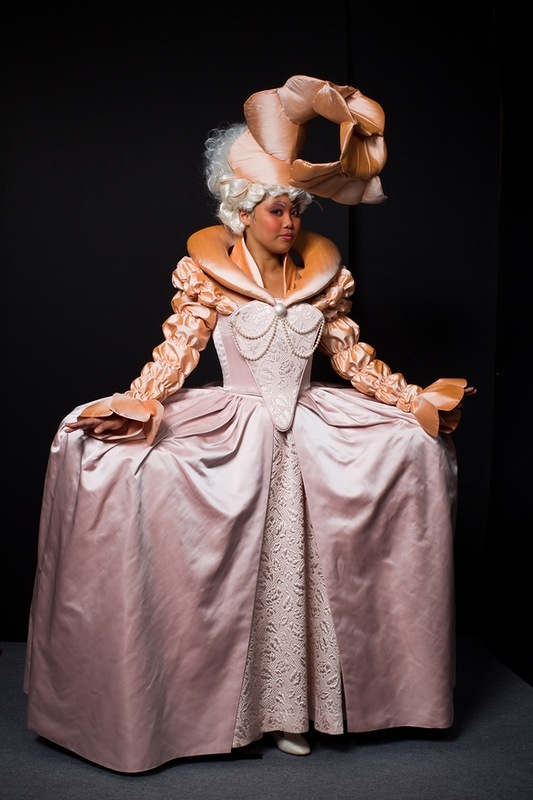
The setting for Mirror Mirror is very much 'once upon a time, in a land far, far away', and so the film is not bound to any specific time period or location. But most of the costumes seem to be inspired by 18th century court dress. There are powdered wigs and voluminous skirts in abundance.


My personal favorite is this beautiful dress Snow White wears at the beginning. The colors are just gorgeous; but what makes this piece a real beauty is the little applique flowers and butterflies that look almost alive.


Snow white's badass-trained-by-dwarfs look was my second favorite. And it's actually something I would wear in real life. Maybe the corset over a bright blue peasant blouse is a bit too much, but those pants look very comfortable.


My friend and reluctant movie companion was of the opinion that the best part of this flick was the Prince's coat. Which was, admittedly, very impressive.


I loved how Snow White's palette changed throughout the film. She starts with a delicate pastel dress, and then we see her in white, followed by the blue and black look and finally this gorgeous white, blue and orange frock. My guess is that brighter, stronger colors signify character development. Though there is very little of that going on.


The masquerade ball gives us some pretty bland 'symbolic' costumes for the main cast: peacock, swan and rabbit.


But it's the supporting cast that really gets to shine. It seems that everyone at this party is wearing a fauna-themed costume. And they are quite creative. Walrus, shrimp, chicken, moose.


The evil queen is the one who steals the show with her gorgeous dresses. The skirts are huge, the shoulders are prominent and the collars are impressive. All her costumes are ostentatious and extravagant. And yet the character is very lovable. I have to say, more so than the dopey prince or the naive heroine.


I would recommend seeing this film in the cinema. It looks quite stunning on a big screen. But it's more fluff than substance and you shouldn't expect a provocative plot or depth of character. For a modernized fairy tale it's more of the same.        
Related Posts Plugin for WordPress, Blogger...