Showing posts with label Regency. Show all posts

Sunday, March 22, 2020

Red Cloaks in Regency England

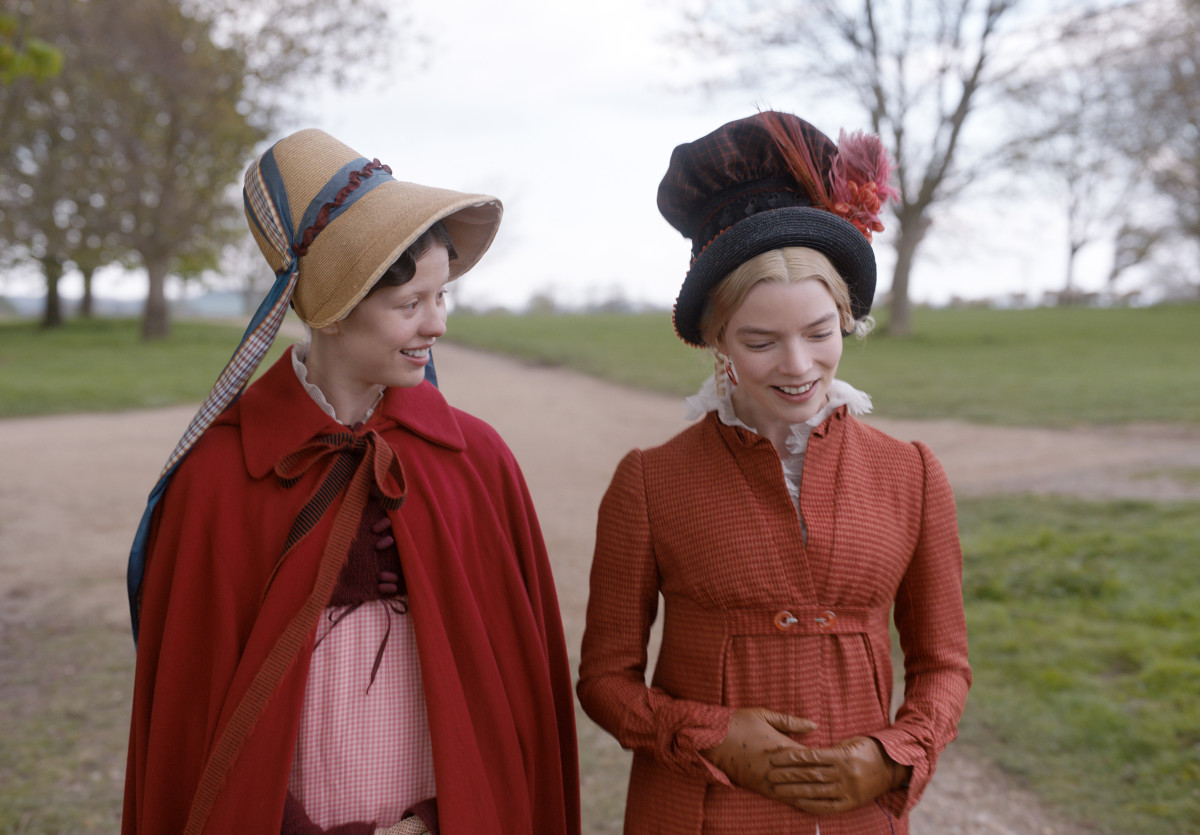
Outerwear contrast between Harriet and Emma.
Color coordination on point,  Harriet and Emma. Photo via Focus Features
One of the very fun costuming choices made by Alexandra Byrne for the new EMMA. (2020) is the matching red cloaks worn by the pupils from Mrs Goddard's school. Emma's new BFF, Harriet Smith wears just such a red cloak. 

The red cloaks and bonnets seem to strike some as a reference to the similar uniforms in Handmaid's Tale. Autumn de Wilde does not shy away from this comparison, but states that: 
"[Regency] schoolgirls would have worn that type of bonnet and those capes. It's an identifier of Harriet's class position." [Fashionista]
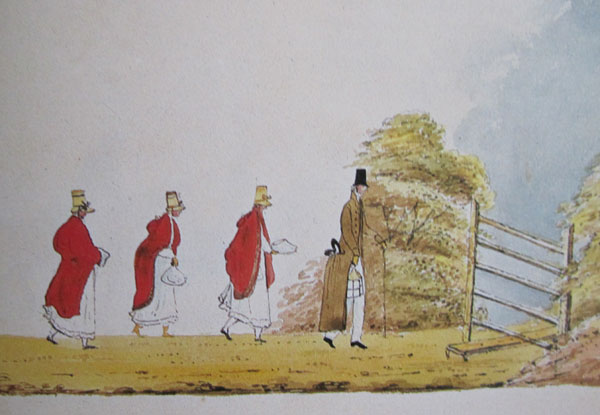
Hazards of walking, Diana Sperling, 
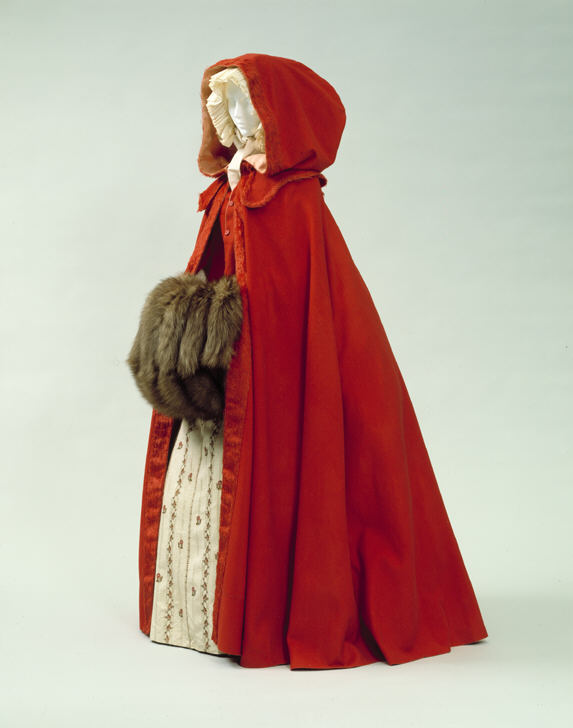
Woolen red cloaks were practical attire for working class women and for country wear. Such a cloak was cut on a bias and made of closely woven wool, the hem left raw. Due to their simple construction, they could be sold ready-made, and were, consequently, more affordable than more tailored spencers or pelisses.    

Thomas Rowlandson, 1811, A Midwife Going to a Labour
Match Woman, John Dempsey, 1824, Woolwich
These cloaks were sometimes called the "cardinal" becasue of the red color.

Cape, last third 18th century, American or European, The MET 
The look may be familiar to all of you Jane Austen film buffs out there. Lydia and Kitty wear them in the 1995 adaptation of Pride and Prejudice (costumes by Dinah Collin). The bright color expresses their loud and brash personalities. In contrast, Elizabeth's spencer is mustard, to make her stand out, but seem more grounded, while Jane is in angelic blue and poor Mary is barely visible in her brown cloak.     


While these were sensible garments, red cloaks did make their way into fashion plates of the period.

Walking dress from La Belle Assemblée (Mar 1811)
"...Cassimere crimson mantle, confined close to the back, lined with purple silk, embroidered round the neck, cape, and sides with purple fancy border; a deep cape falling from the shoulders, sloping to a narrow point, with tassels. A crimson velvet bonnet, turban front and trimmed with purple to correspond...” 
- La Belle Assemblée, 1811 
This very fashionable lady wears a "mantle" instead of a "cloak". It seems that these cloaks remained a fashionable part of the walking dress and could be occasionally seen with evening dresses. 

Fashion plate, 1829, France via V&A Museum
Red accents appear in many of the fashion plates of the time, though mostly this comes in the form of a shawl rather than a cloak.


Harriet Smith's simple red cloak signifies her class position. She is not as wealthy as Emma and cannot afford fitted winter garments. At the same time, it shows her simplicity, as she takes her walks    

SOURCES: 
- Dress in the Age of Jane Austen: Regency Fashion, by Hilary Davidson 
  Yale University Press (November 12, 2019)
- Metropolitan Museum of Art

Monday, March 16, 2020

Movie Review: EMMA. 2020

I went to see Emma (2020) today with a few friends. I will not lie - I loved it! And, so, naturally, I had to share my thoughts about this movie. Spoilers ahead!

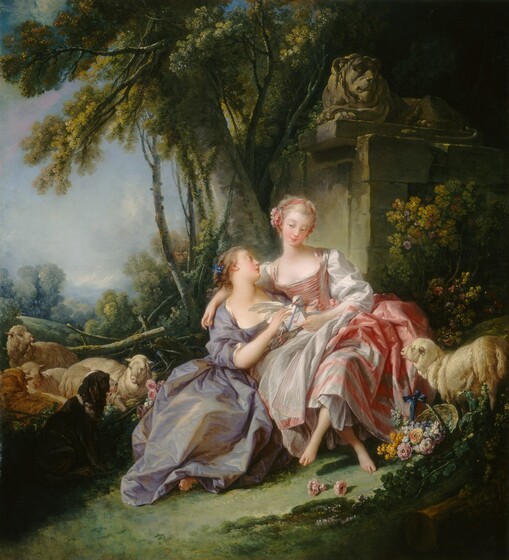
Directed by Autumn de Wilde and written by Eleanor Catton, this sparkling period drama stars Anya Taylor-Joy as Emma Woodhouse and Johnny Flynn as Mr. Knightley. Everyone and their mother have said this already, but I shall add my voice to the chorus - the movie is visually stunning! The soft pastels, the warm lighting, and the floral motifs bring to mind a rococo pastoral painting.

Image result for rococo art paintings
The Love Latter, François Boucher, 1750 
via Universal
But they also put me in mind of works by Regency caricaturists such as James Gillray. This is not an accident, both the costume designer and the director took inspiration from satirical cartoons and fashion plates of the period(1). The result is a lush, saturated color palette, but also a wry and cheeky approach to the source material.   

Matrimonial-Harmonics, James Gillray, 1805 via Wikimedia Commons

The dialogue is mostly taken straight from the book and most of Austen's plot remains intact. A few things are cut here and there in the interest of time; a few things are added to keep with the tone and visual medium of the film. I quarrel with none of these. For the most part, I have no complaints about the changes made.   

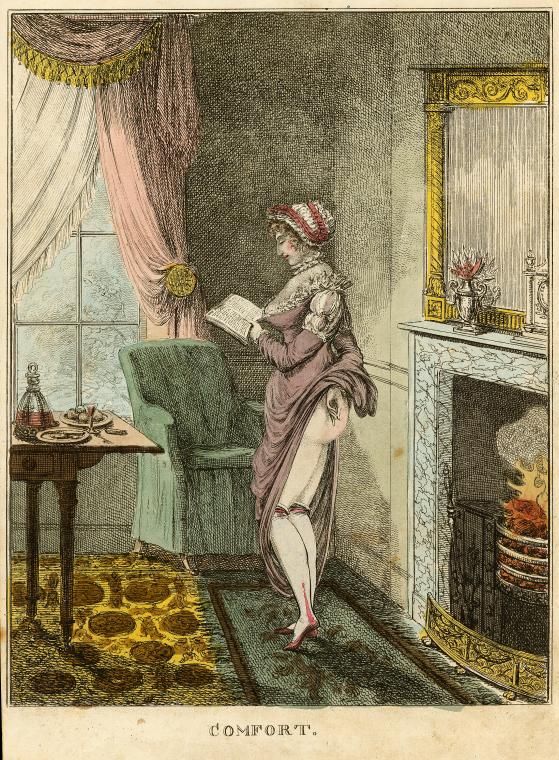
I have heard that some people had expressed concern regarding certain posteriors that appear in the film. It is true, many of Jane Austen's adaptations up until now have been rather buttoned-up. But we must remember that behinds are very period appropriate. In fact, they show that de Wilde is clearly familiar with the visual culture of the time:

Index
Comfort, Charles Williams, 1796 
The only thing I can find fault with is the pacing. The transitions from one scene to another are a little clunky at times. But individual scenes are invariably perfect. Autumn de Wilde is able to tell the story visually so well that I sometimes felt that there was no need for dialogue at all.

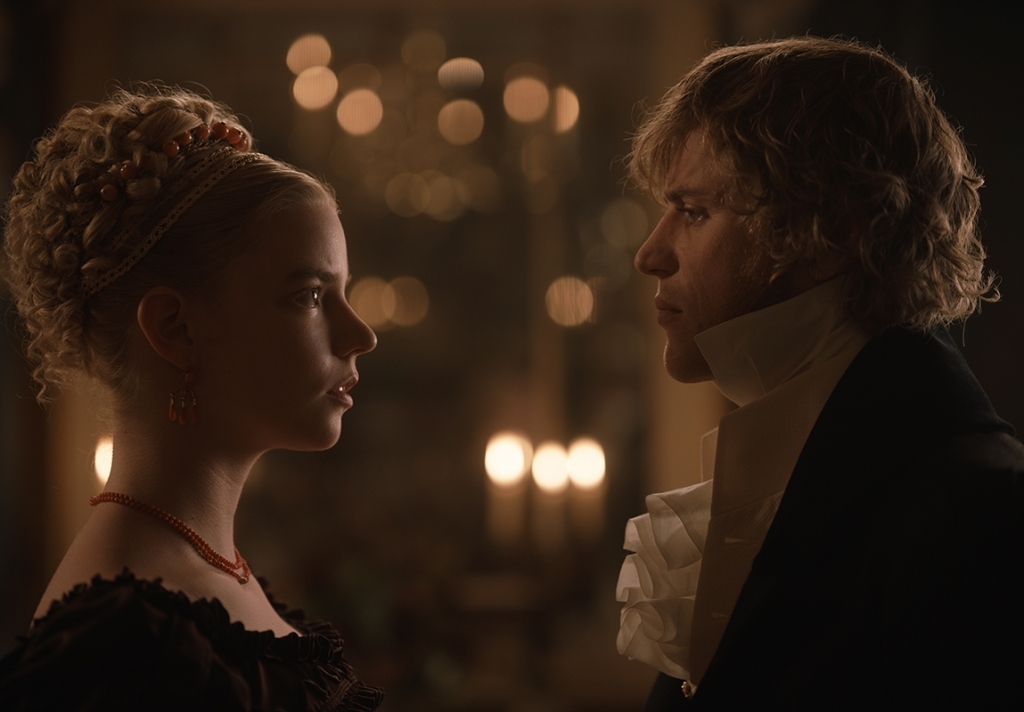
Emma (Anya Taylor-Joy) and Mr. Knightley (Johnny Flynn) via Universal 
Her talent in setting the scene and visual story telling is greatly assisted by a frankly astounding cast. Almost every single person seems like they were born to play this exact role. Anya Taylor-Joy, as the self-assured Emma is wonderful. Her face is incredibly expressive, which makes watching Emma's character as she unravels so much fun.

Johnny Flynn is by far my favorite Mr. Knightley. He brings a blend of manliness and softness that makes you fall in love with him over the course of the movie. I have heard some complain that Flynn is not old enough to play Knightley. He is 36 to Taylor-Joy's 23. In the book, Emma and Knightley are 21 and 37 respectively. In the new adaptation, Knightley may appear younger becasue he does not take the sanctimonious, dictatorial tone that other directors tended to ascribe to the character. He acts more in line with what a contemporary man of 36 would be like with a friend, rather than a father-figure of ye olden days. 

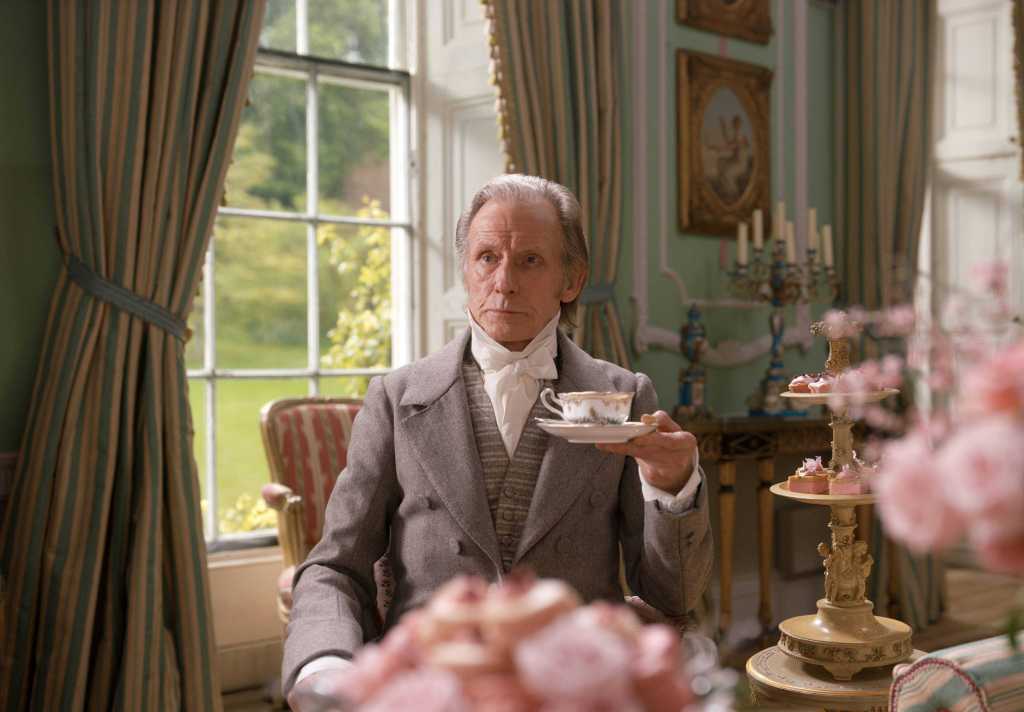
Mr. Woodhouse (Bill Nighy) via Universal  
Bill Nighy as Mr. Woodhouse is a delight. His hypochondria is still there, but it is off-set by a sprightly and energetic manner, which makes it so much more hilarious.

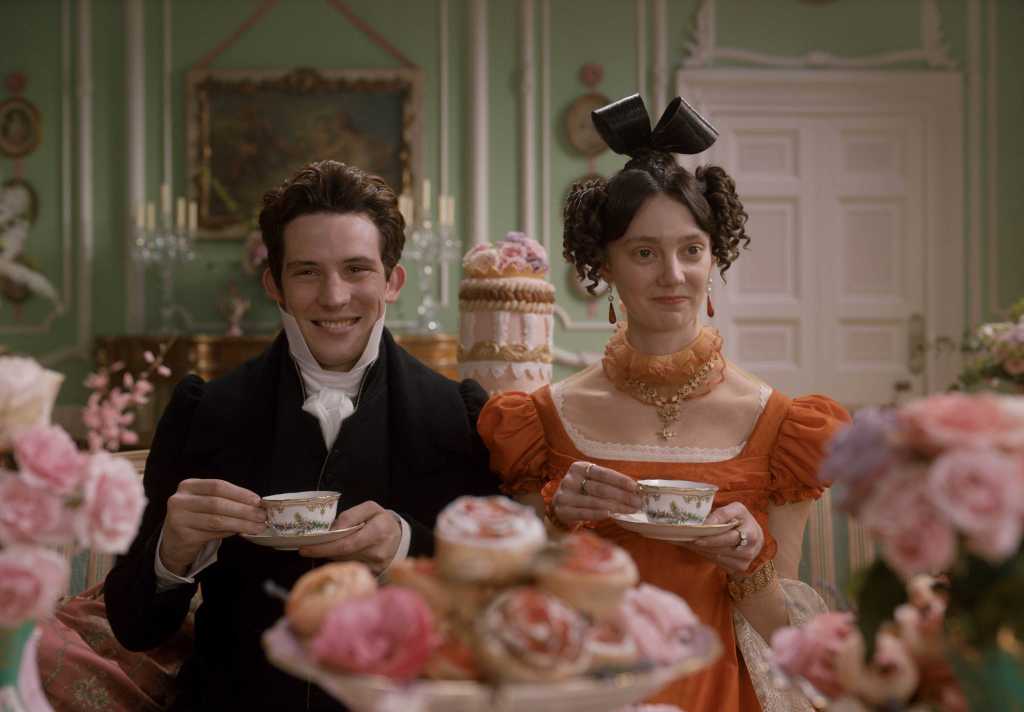
Mr and Mrs Elton, via Universal 
Miranda Hart as Miss Bates is the breakout star of the movie. She makes Miss Bates as annoying as humanly possible, yet when she is hurt, her pain is palpable. The Eltons are perfectly cast. Mr Elton (Josh O'Connor) is just as smarmy and simpering as you'd expect. Mrs Elton (Tanya Reynolds) is overbearing and over-trimmed. She is a great contrast to Emma, almost as a reminder that this is what Emma could have been if she did not have such a good head and heart.

Callum Turner in Emma. (2020)
Frank Churchill (Callum Turner) via IMDB
The rest of the cast is equally wonderful. The only two I would mention here is Amber Anderson as Jane Fairfax and Callum Turner as Frank Churchill. Anderson gets very little screen time as Jane, and since her character is rather reticent, little can be said about her. The only one who comes close to being miscast is Callum Turner as Frank Churchill. Turner does the character justice, but he just does not have much to work with. He also does not have the disarming charm of Ewan McGregor (who played Frank in 1996 Emma).       

Overall, I would say this is now my favorite adaptation of Emma (Clueless, naturally, notwithstanding). It feels modern and fresh, without any of it feeling forced. However, this may not be a version for everyone. If you come to this film looking for sentimentality, you will not find it. This is a broad comedy, a farce, where all the situations and characters are a little (or a lot) absurd. Fortunately, that is exactly how I like my Emma adaptions.   

This review is too long, so I defer gushing about the costumes to a latter date.

1. AUTUMN DE WILDE ON THE DREAMY, COLORFUL AND PERIOD-AUTHENTIC STYLE IN 'EMMA', Fashionista

Saturday, July 13, 2013

Keep it Cool: Historical Fans

As we've been hit by quite a heatwave, what's a girl to do but to break out her secret stash of fans. The advantages of fans are numerous: you can keep yourself cool, add another accessory to your outfit, or let someone special know what you think about them.

Take this Horrible Histories' lady for instance. She knows how useful a fan could be:


The wonderful thing about fans is that they come in all shapes, sizes and color schemes. You can always find the perfect one to compliment your outfit.

So I leave you today with a collection of my favorite fans. I defer a post about the language of the fan to a later date.

Fixed fan, straw embroidery on green silk with wooden handle, 1740, England via LACMA


Folding fan, ivory and paper, 18th century, Spain via the Met Museum

Calendar fan, silk leaf printed and painted, wood and ivory handle, 1774, France via Museum of Fine Arts Boston

Brisé fan, ivory, paper and tortoiseshell, 1790–1820, France via the Met Museum

Folding fan, pierced and painted ivory, 1710-20, China for Dutch market via Cooper-Hewitt

Brisé fan, ivory, 1800s, China via the Kyoto Costume Institute

Folding pleated fan, only 17.8 cm tall and 33.6 cm wide, 1805-1810, France via Cooper-Hewitt

Brisé fan, ivory, metal and oil paint, 1800-1810, France via the Met Museum

Edouard Moreau fan, paper, parchment, paint, mother-of-pearl, metal, 1860–75, France via the Met Museum  

Fan, 1830-60, silk and tortoiseshell, France via the Met Museum  

Fan, graving colored with gouache on paper, with painted wooden sticks, 1830-1840, France via Victoria and Albert Museum

Fan, silk and ivory fan painted with roses, 1845 via Museum of the City of New York

Fan, paper, ivory, metal and glass, 1860s, America or Europe via the Met Museum  

Folding cockade (circular) fan, vulcanized rubber and silk ribbon. 1860s, United States via Cooper-Hewitt

Fan, mother-of-pearl, silk, gouache and metal, 1880-1900, America or Europe via the Met Museum  

Fan, wood, paper, wool and silk, late 19th century, French via the Met Museum 

Fan, painted silk gauze and bobbin lace leaf, with mother-of-pearl sticks and guards, 1890-1900, France via Victoria and Albert Museum

L.(?) Boillaty fan, paper, silk, lace, mother-of-pearl and gilt, late 19th century France via the Met Museum 

Fan, paper and wood, 1903, France via the Met Museum 

Fan, 'L'OCCIDENTALE', vellum; pochoir of woman holding flower in scene with ocean and mountain; illustrated by Paul Iribe, 1911 via the Kyoto Costume Institute


Fan, 1910-1920, France via the Met Museum


Fan, mother+of-pearl and silk, 1920, France via the Met Museum


Fan, silk and celluloid, 1925, France via the Met Museum


Fan, paper, wood and metal, 1925, France via the Met Museum


Fan, synthetic, feather and metal, 1925-1935, European or American via the Met Museum


Shulton, Inc. fan, paper, 1939 American via the Met Museum


Fan, plastic and cotton, spring/summer 1989, France via the Met Museum

Which of these do you like best? Or do you have your very own favorite fan? Let me know!  

Wednesday, June 5, 2013

BBC Recreates the Netherfield Ball

To celebrate the bicentennial of Jane Austen's Pride and Prejudice, BBC decided to recreate one of the pivotal moments in the book, the Netherfield ball. The ball, held by Mr. Bingley, becomes the venue for our Lizzy Bennet's many embarrassments and misunderstandings.

Every savage can dance. Source: BBC News
The hour and a half Pride and Prejudice: Having a Ball documentary with Amanda Vickery and Alastair Sooke is a wonderfully detailed recreation of the food, fashions, manners and dances of the Regency. While a lot of this is not ground breaking material,  for anyone who wants a crash-course in Regency fine living or looking to understand the nuances of Jane Austen's writing, this program is the perfect place to start.    

Food 
The food at a 1813 ball would have been highly ornate and grand. But to our modern sensibilities it would have also looked slightly disgusting. My favorite weird food was the whole chicken with legs and head, beak and all, still in place and a jello with about six little crayfish inside.

Whole chicken was quite a delicacy. Source: BBC News 
Fashion     
Regency fashion, unlike our contemporary duds, was not mass produced. Most dresses were made at home or with the help of a seamstress. That would have meant that at a ball one would see a much broader range of fabrics, patterns, flounces and styles than one could possibly find at any modern party. The individual style of the wearer would be that much more visible. And so good or bad taste would be that much more important.

All  dressed up and ready to party. Source: BBC News

Lighting 
Fun fact about candles during the time is that they were sold by length. There were four hour or six hour candles. So just by looking at the candles the guests would know how long the party was going to last. The rich could afford beeswax candles that gave off more light, while the poor had to be content with tallow candles that were made of animal fat and smelled foul.

Beeswax candles - a real status symbol. Source: BBC News
Dance 
Balls in period films often look like stately affairs, with lots of slow, pristine gliding around the rooms. But most English country dances actually involved a lot of complicated steps and quite a bit of jumping and prancing that would leave even modern professional dancers slightly out of breath. What's more, some dances were so complicated that special paper fans were available with little cheat-sheets on the back, that showed the music and the steps that one had to follow.

Are they feeling warm or trying to memorize dance steps? Source: BBC News 
You can watch the the whole documentary here. Or visit the BBC website for more fun facts and mini-documentaries.

Saturday, April 27, 2013

Lady's Accessory: History of Handkerchief

My theater group was working on a play and for one of the scenes we needed a blood-soaked handkerchief. So, I set out to make one out of bit of linen I had lying around.


And it got me thinking, where did handkerchiefs come from?  Modern Woman magazine wrote this about the origins of handkerchief in 1940:
"Historians credit Marie Antoinette with the invention of the pocket handkerchief. She was so broken up at leaving her home in Austria that she cried all the way to France and wiped her eyes with bits of lace torn from her dress and lingerie. Anticipating future tears, she made it a point always to have a piece of lace tucked in a pocket of her dress. This, say the historians, was how handkerchiefs were born." - via Bobby Pin Blog
This is a lovely, sentimental story, but it's probably not true. Marie Antoinette must have spent quite a bit of her time crying, but she was not the first person to use pieces of cloth to wipe away her tears.

Rose Bertin, La Galerie des modes, 1770s 

Some believe that the handkerchief was invented by King Richard II of England (1377-1399). His courtiers noted that he used square pieces of cloth to wipe his nose. But it is very likely that handkerchiefs existed as far back as the Roman times. Poet Gaius Valerius Catallus (84BC) mentions something that could be an equivalent of a modern napkin or handkerchief in his writing.
Linens whose loss affects me not for worth
But as mementoes of a comrade mine.
For napkins Sætaban from Ebro-land
Fabúllus sent me a free-giftie given
Also Veránius: these perforce I love
E'en as my Veraniólus and Fabúllus. - The Carmina of Caius Valerius Catullus
Handkerchief were not only practical items but also wonderful keepsakes that people would give each other as presents. Much of Shakespeare's Othello revolves around a misplaced handkerchief.
Iago Nay, but be wise: yet we see nothing done;
She may be honest yet. Tell me but this,
Have you not sometimes seen a handkerchief
Spotted with strawberries in your wife's hand?
Othello I gave her such a one; 'twas my first gift. - Othello by William Shakespeare
Othello and Desdemona, Daniel Maclise, 1859 

Handkerchiefs were usually made of fine linen, cambric or lawn cloth with rich embroidery or lace along the edge. During the Renaissance they were used for hygiene purposes, but they also gained popularity as fashionable accessories for the wealthy. It is possible that the fad began with the court ladies in Italy and slowly made its way to Germany and France.

 A Woman Holding a Handkerchief, Paris Bordone, 1530s(?) 

They eventually reached the court of Queen Elizabeth I of England, and judging from the portraits of the time were used to signify the prosperity and status of their owners. Elizabeth herself had quite a collection of handkerchiefs which were mostly New Year gifts from her loyal subjects.

Portrait of Lady Diana Cecil, William Larkin,1614

Handkerchiefs were often perfumed to ward off unwanted smells or revive their owners should they faint from fatigue or excessive sensibility. It is very likely that Mrs. Bennet from Pride and Prejudice utilized a handkerchief during her bouts of nervousness.

Alison Steadman as Mrs. Bennet in Pride and Prejudice (1995)

Fashion plates of the 18th and 19th centuries abound in pictures of fashionable ladies clutching pieces of cloth in their hands. However, when reading sources from this period, it is not always clear whether handkerchief refers to a pocket handkerchief as we now it today or to a kerchiefs that covered a lady's neck and bosom for modest day wear.

Costume Parisien, 1824

Henry Tilney from Jane Austen's Northanger Abbey knows a thing or two about ladies' dress. He suggest that muslin could always be turned to good use if it is made over into caps, cloaks or handkerchiefs.
"But then you know, madam, muslin always turns to some account or other; Miss Morland will get enough out of it for a handkerchief, or a cap, or a cloak. Muslin can never be said to be wasted. I have heard my sister say so forty times, when she has been extravagant in buying more than she wanted, or careless in cutting it to pieces." - Northanger Abbey by Jane Austen  
Yet from the context it would seem that he is talking about kerchiefs rather than pocket handkerchiefs.

Evening dress, Ackermanm's Repository, 1818 

Ackermann's Repository of Fashions from 1829 has this to say about a new fashion involving a pocket handkerchief.
An attempt is making to bring into fashion pocket handkerchiefs very richly embroidered, the centre of which, by means of a riband, passed through a row of open work, forms a purse. The idea is novel, but in very bad taste; as yet it has been adopted only by a few merveilleuses. Those used by élégantes of acknowledged taste, are of two sorts ; the most elegant have a very broad hem, close to which is a row of open work of about an inch in breadth, each corner is ornamented with a butterfly most beautifully shaded; or else a bouquet of flowers coloured after nature. The other sort which are pretty, but not so expensive, have a broad hem, and a border of open work, close to which is a coloured Grecian border from an inch to an inch and a half in breadth. - Ackermann's Repository, 1829
It would seem that some Parisian fashionista were trying to style a sort of reticule out of a handkerchief, though the author of this review seems unimpressed.

Some beautiful examples of pocket handkerchiefs:

An imperial fine linen handkerchief, 19th century, Russia via Christie's  
Linen handkerchief, Venetian needlepoint, 1700s via Gathering the Jewels 

Handkerchief, Convent of Notre Dame de Visitation, 1865 via Met Museum

Today handkerchiefs have been replaced by napkins and paper towels; though they are still used in men's formal wear. However, we should endeavour to bring back these elegant and useful pieces of cloth. You can find real beauties from the 1930s and 1950s in vintage and second hand stores.

But if you want something a little more refined, make one yourself. Here is a simple tutorial that shows you how to sew a pocket handkerchief by hand. You can spice them up with some lovely embroidery. Whitework looks especially lovely. Monogrammed handkerchiefs make lovely gifts and if you start now you will have a few dozen ready by Christmas. And this lovely tutorial will show you how to make a scented handkerchief.

More on the topic:
A Brief History of the Handkerchief in Europe during the Late Middle Ages through the Renaissance by Margaret Roe
An Intimate History of the Handkerchief by THL Genevieve de Valois
Vulgar Things by Hannah Carlson, Common-Place 
Handkerchief Heroes
Bobby Pin Blog
Related Posts Plugin for WordPress, Blogger...