Showing posts with label Pride and Prejudice. Show all posts

Sunday, March 22, 2020

Red Cloaks in Regency England

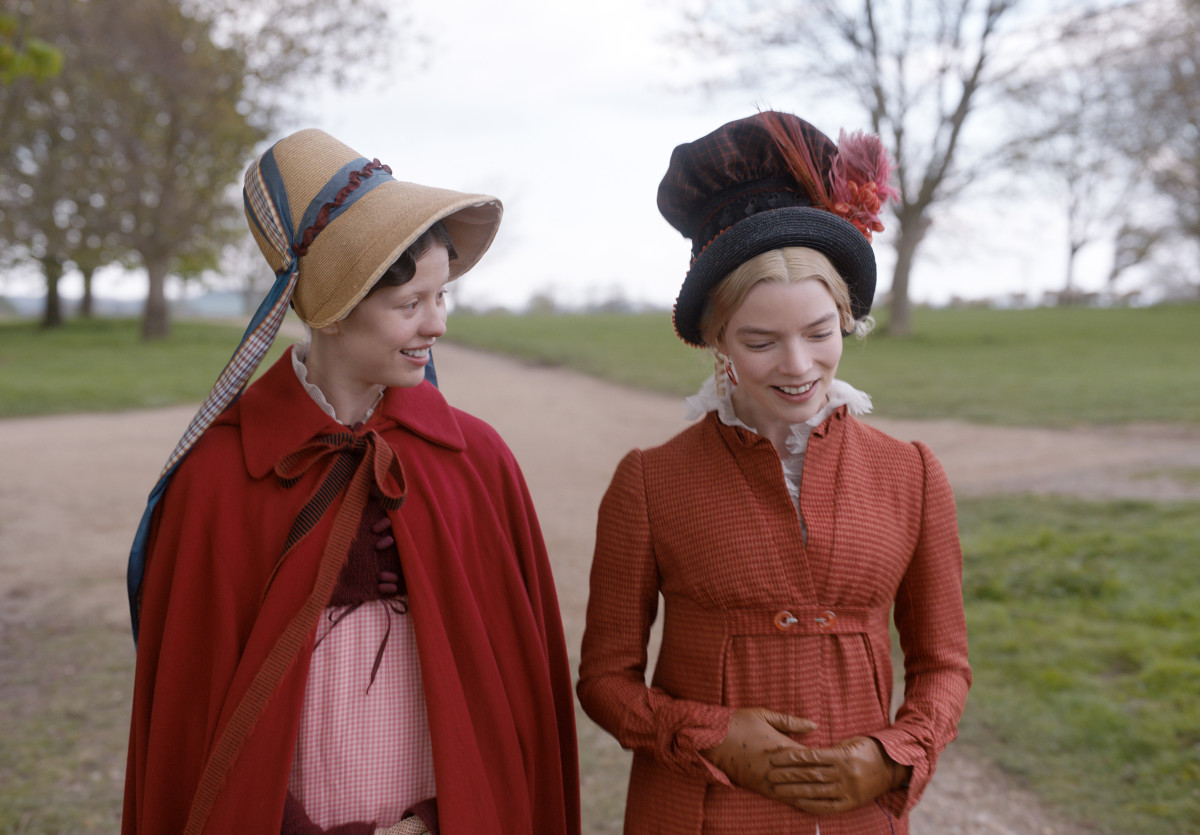
Outerwear contrast between Harriet and Emma.
Color coordination on point,  Harriet and Emma. Photo via Focus Features
One of the very fun costuming choices made by Alexandra Byrne for the new EMMA. (2020) is the matching red cloaks worn by the pupils from Mrs Goddard's school. Emma's new BFF, Harriet Smith wears just such a red cloak. 

The red cloaks and bonnets seem to strike some as a reference to the similar uniforms in Handmaid's Tale. Autumn de Wilde does not shy away from this comparison, but states that: 
"[Regency] schoolgirls would have worn that type of bonnet and those capes. It's an identifier of Harriet's class position." [Fashionista]
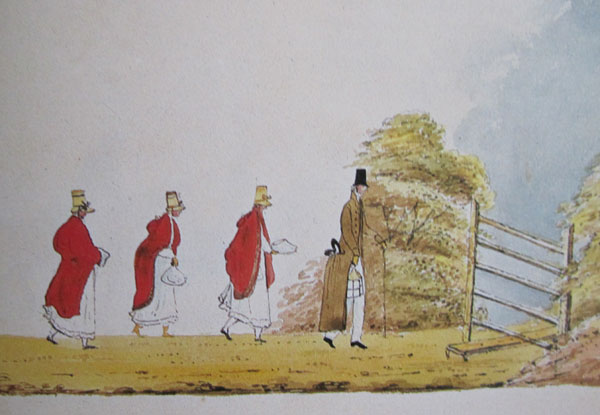
Hazards of walking, Diana Sperling, 
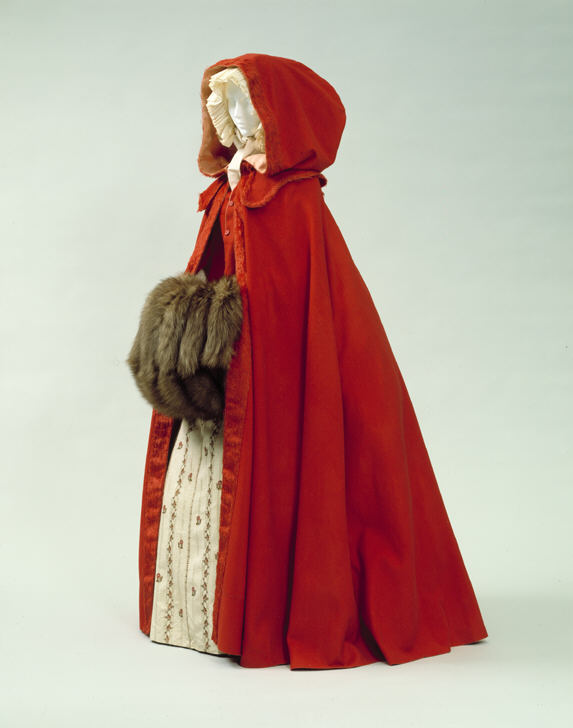
Woolen red cloaks were practical attire for working class women and for country wear. Such a cloak was cut on a bias and made of closely woven wool, the hem left raw. Due to their simple construction, they could be sold ready-made, and were, consequently, more affordable than more tailored spencers or pelisses.    

Thomas Rowlandson, 1811, A Midwife Going to a Labour
Match Woman, John Dempsey, 1824, Woolwich
These cloaks were sometimes called the "cardinal" becasue of the red color.

Cape, last third 18th century, American or European, The MET 
The look may be familiar to all of you Jane Austen film buffs out there. Lydia and Kitty wear them in the 1995 adaptation of Pride and Prejudice (costumes by Dinah Collin). The bright color expresses their loud and brash personalities. In contrast, Elizabeth's spencer is mustard, to make her stand out, but seem more grounded, while Jane is in angelic blue and poor Mary is barely visible in her brown cloak.     


While these were sensible garments, red cloaks did make their way into fashion plates of the period.

Walking dress from La Belle Assemblée (Mar 1811)
"...Cassimere crimson mantle, confined close to the back, lined with purple silk, embroidered round the neck, cape, and sides with purple fancy border; a deep cape falling from the shoulders, sloping to a narrow point, with tassels. A crimson velvet bonnet, turban front and trimmed with purple to correspond...” 
- La Belle Assemblée, 1811 
This very fashionable lady wears a "mantle" instead of a "cloak". It seems that these cloaks remained a fashionable part of the walking dress and could be occasionally seen with evening dresses. 

Fashion plate, 1829, France via V&A Museum
Red accents appear in many of the fashion plates of the time, though mostly this comes in the form of a shawl rather than a cloak.


Harriet Smith's simple red cloak signifies her class position. She is not as wealthy as Emma and cannot afford fitted winter garments. At the same time, it shows her simplicity, as she takes her walks    

SOURCES: 
- Dress in the Age of Jane Austen: Regency Fashion, by Hilary Davidson 
  Yale University Press (November 12, 2019)
- Metropolitan Museum of Art

Wednesday, June 5, 2013

BBC Recreates the Netherfield Ball

To celebrate the bicentennial of Jane Austen's Pride and Prejudice, BBC decided to recreate one of the pivotal moments in the book, the Netherfield ball. The ball, held by Mr. Bingley, becomes the venue for our Lizzy Bennet's many embarrassments and misunderstandings.

Every savage can dance. Source: BBC News
The hour and a half Pride and Prejudice: Having a Ball documentary with Amanda Vickery and Alastair Sooke is a wonderfully detailed recreation of the food, fashions, manners and dances of the Regency. While a lot of this is not ground breaking material,  for anyone who wants a crash-course in Regency fine living or looking to understand the nuances of Jane Austen's writing, this program is the perfect place to start.    

Food 
The food at a 1813 ball would have been highly ornate and grand. But to our modern sensibilities it would have also looked slightly disgusting. My favorite weird food was the whole chicken with legs and head, beak and all, still in place and a jello with about six little crayfish inside.

Whole chicken was quite a delicacy. Source: BBC News 
Fashion     
Regency fashion, unlike our contemporary duds, was not mass produced. Most dresses were made at home or with the help of a seamstress. That would have meant that at a ball one would see a much broader range of fabrics, patterns, flounces and styles than one could possibly find at any modern party. The individual style of the wearer would be that much more visible. And so good or bad taste would be that much more important.

All  dressed up and ready to party. Source: BBC News

Lighting 
Fun fact about candles during the time is that they were sold by length. There were four hour or six hour candles. So just by looking at the candles the guests would know how long the party was going to last. The rich could afford beeswax candles that gave off more light, while the poor had to be content with tallow candles that were made of animal fat and smelled foul.

Beeswax candles - a real status symbol. Source: BBC News
Dance 
Balls in period films often look like stately affairs, with lots of slow, pristine gliding around the rooms. But most English country dances actually involved a lot of complicated steps and quite a bit of jumping and prancing that would leave even modern professional dancers slightly out of breath. What's more, some dances were so complicated that special paper fans were available with little cheat-sheets on the back, that showed the music and the steps that one had to follow.

Are they feeling warm or trying to memorize dance steps? Source: BBC News 
You can watch the the whole documentary here. Or visit the BBC website for more fun facts and mini-documentaries.
Related Posts Plugin for WordPress, Blogger...