Showing posts with label 1800s. Show all posts

Thursday, March 26, 2020

Poor Spinsters in Regency England | The Case of Miss Bates in Emma

Miranda Hart plays Miss Bates in the latest big screen version of Jane Austen's Emma.
Miranda Hart as Miss Bates, Emma 2020  
Single women have a dreadful propensity for being poor, which is one very strong argument in favour of matrimony. - Jane Austen's Letters 
I have recently went to see EMMA(2020). And while there is much to say about this cheeky, pastel-colored adaptation of the classic, my thoughts often turned to poor Miss Bates, played to perfection by Miranda Hart.

In Jane Austen's Emma, Miss Bates is the staple of Highbury society. She is neither clever nor pretty (and never was), she is talkative and cheaper, lives with her mother, and is generally well liked. She is also an old maid and very poor.

I have recently had an occasion to contemplate the relationship between single-hood and poverty. Not just in the distant past, but in our contemporary world. Sure, having a large family and children can be quite a drain on one's resources, too. But being a single woman of a certain age with a limited income (and dependents, such as aging parents) is just as difficult today as it was in 1815*.

A teacher or governess. School, 1810. British Museum 1917,1208.1237
School; James Godby, 1810; London via The British Musseum
In Jane Austen's England, single women of genteel birth had few options of earning an income. They could become paid companions or teachers and governesses (provided they had found themselves into a little education). There were some options of entering into a feminine profession such as a dressmaker, but that too required industry and  a good head for finances, as well as skill. However, all professions meant a loss of social standing. Consequently, the best a single woman without an independent income could do is to retain an appearance of gentility on a small income. Provided she was grateful and cheerful like Miss Bates, she could hope to be well-liked, but she had no certainty of being respected.

Gwyneth Paltrow in Emma (1996)
Gwyneth Paltrow as Emma, 1996
In the novel, Emma proclaims that she shall never marry. And when Harriet Smith with utter horror asks whether that means that she would be an old maid, Emma coolly replies:
I shall not be a poor old maid; and it is poverty only which makes celibacy contemptible to a generous public! A single woman, with a very narrow income, must be a ridiculous, disagreeable old maid! the proper sport of boys and girls, but a single woman, of good fortune, is always respectable, and may be as sensible and pleasant as any body else. 
This distinction between the poor old maid and a rich one may strike the 21st century reader as ridiculous. But I invite you think about our contemporary discourses on single women. A single career woman can find acceptance, even adulation, for being a #GirlBoss. But if one is unfortunate enough to have neither a career (or even a job) nor a partner, one might be subjected to the same kind of contempt and pity as any poor spinster in Regency England.
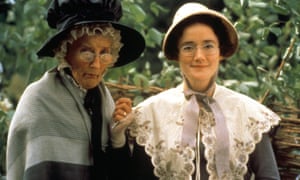
Phyllida Law Sophie Thompson Emma
Phyllida Law (Mrs Bates) and Sophie Thompson (Miss Bates) Emma, 1996 
But let's look at "poor old maid" and try to understand what that entails. I'll be using Miss Bates as a case study.
First, who is an old maid? Well, it's definitely a woman - hence, the "maid". Unmarried men do not seem to evoke the same level of contempt and ridicule. But how old is an "old maid"? Jane Austen has very few spinsters in her novels. A few of her characters hover on the edge of spinsterhood, but are usually rescued from it by a timely proposal.

In Pride and Prejudice, Lydia exclaims that:
Jane will be quite an old maid soon, I declare. She is almost three-and-twenty! Lord, how ashamed I should be of not being married before three-and-twenty!
But then again, Lydia is a very foolish character. And it's very unlikely that anyone but this flighty teen would consider the sweet and beautiful Jane at 22 to be a spinster. 

Ch 13.1 Inspiration for the colour of Mary's blue-Gray ball gown for the Netherfield ball. Charlotte Lucas in the 1995 version of pride and prejudice.
Charlotte Lucas (Lucy Sccott) P&P, 1995
Charlotte Lucas, one the other hand, is more generally considered to be on her way to spinsterhood. She is 27 and has no fortune.  But she extricates herself from the unfortunate fate by snagging Mr. Collins just in time.

Elizabeth Elliot in Persuasion is nearing her 30th birthday, and she feels that she's approaching
 ...the years of danger, and would have rejoiced to be certain of being properly solicited by baronet-blood within the next twelvemonth or two.
We don't know whether Miss Elliot ever marries, but she has rank and (some) wealth on her side. At any rate, she will most likely be spared the indignity of real poverty in spinsterhood. Anne Elliot is 27 at the beginning of the novel, and she is treated by most people as a spinster.

Anne Elliot (Sally Hawkins) Persuasion, 2007 
From Austen's work we can glean that spinsterhood begins around late 20s and early 30th. However, spinsterhood is clearly not about age, or not entirely about age. While Elizabeth Elliot worries about her unmarried status, she is not treated as a spinster by those around her. Anne Elliot, on the other hand, is expected to always be convenient to others, whether it is caring for her hypochondriac sister Mary or playing the piano, while others dance. An old maid is thus defined not only by her age, but also by her social status. Wealth and rank play an important part in this, but as the comparative cases of Elizabeth and Anne Elliot show, spinsterhood is more about how others relate to you. An old maid is a woman who does not (or cannot) do as she pleases.

This makes poverty an important components of spinsterhood. I am talking about relative poverty. In Emma, Miss Bates is not from the laboring classes. Her father was the vicar of Highbury (the position now occupied by Mr. Elton). But her present situation is that of relative destitution, made worse by the fact that she has known comfort and some prosperity in her youth.

Image result for miss bates
Miss Bates (Tamsin Greig) Emma, 2010  
Austen is often very explicit about everyone's income in her novels, whether large or small. But we have to guess how much Miss Bates has. We know that on their income, Mrs. and Miss Bates can only afford one maid and have to rent lodgings above some shop or business premises in Highbury. Miss Bates's monologues are full of communications about provisions, daily routines, and food. Emma find this tiresome; but for Miss Bates these are not trivial matters - she is trying to economize wherever she can and is grateful to neighbors and friends for gifts and attention.

Emma, Illustration by C. E. Brock, 1898, 
Sense and Sensibility is a novel full of clear information about different income brackets. The Dashwood women, on a joint income of £500, can afford two maids and a man and a cottage (though rented to them on very easy terms by a cousin). When Mrs. Jennings contemplates the income of Lucy Steele and Edward Ferrars, after he had been disinherited by his mother, she clearly does not think that they would have more than £150 - £170 per year. Just like Mrs. Bates and Miss Bates they would not be able to afford more than one maid. In a wealthy household like Chatsworth in 1811, a housemaid would earn £11 per year. A "stout girl of all works" that Mrs. Jennings envisions for the young couple would probably come cheaper.

Miss Bates does not keep poultry or cows and does not have a garden. And she has no male relatives who could add to her comforts with any steady flow of cash. In the 1800's, labor was relatively cheap, while goods were expensive. Therefore we can assume that most of the income goes to food, lodgings and some for clothes. Therefore, Miss Bates's income would have been on the lower side of £150.

Constance Chapman and Doran Godwin in Emma (1972)
Miss Bates (Constance Chapman) and Emma (Doran Godwin) Emma, 1972
This income is so small that it cannot comfortably accommodate the addition of Jane Fairfax, who is on the verge of becoming a governess. Miss Bates is in raptures regarding the salary offered to Jane. Considering that when Mary Wollstonecraft went to work as a governess to Lord and Lady Kingsborough in 1786, she was offered a salary of £40**. It is unlikely that Mrs. Elton's friend Mrs. Smallridge would have offered much more to Jane to be a governess. But if Miss Bates's entire household income is around £120-150, even £20 per year for a single person would have appeared to her as immense riches. 

In the end, Jane is save from the terrible fate of being a governess and from the even more terrifying fate of being an old maid by her marriage to Frank Churchill. We can assume that with Jane becoming the new Mrs. Churchill, Miss Bates and Mrs. Bates would acquire some supplement to their income.   

(*) The biggest financial risk for women today? Embarking on a relationship, The Guardian, 2017.
(**) Brandon, Ruth. "Other People's Daughters: The Life and Times of the Governess." Phoenix, 2009.

Sources:
- Copeland, Edward.  “Money.”  The Cambridge Companion to Jane Austen.  Ed. Edward Copeland and Juliet McMaster.  Cambridge: CUP, 1997.
- Craig, Sheryl Bonar. "“The Value of a Good Income”: Money in Emma." Persuasions On-Line: the Journal of the Jane Austen Society of North America 22, 2001.
-  Jacobs, Corrie L. "The ‘Great Talker’: Spinster Stereotypes in Emma".  Jane Austen Society of North America. 2015 Essay Contest Winning Entries, 2015. 
From Servants to Staff: How much? Chatsworth Official Website, News & media ,News, blogs & press releases, 2017

Friday, March 20, 2020

Jane Austen Fan's Reading List

With many people in social isolation, reading material becomes indispensable. But what to do if you have ran out of all of your Jane Austen, including letters and Juvenilia? 

Where to turn next? Here, I will suggest six (plus one) novels to read if you need a Jane Austen fix. 

1. Belinda by Maria Edgeworth
Belinda is a young lady who is introduced to the world of wealth and dissipation by the charming Lady Delacour. The lady in question uses her wit and vivacity to conceal her fears of a terminal illness. There are misunderstandings, petty jealousies and a falling out. Belinda is courted by several young men and there is much speculation over whom she would choose.

This is a charming story. While Belinda is a bit colorless, Lady Delacour is a delight. And this is one the few novels of its kind where one of the principal characters is a person of color. I demand they make it into a mini-series!         

2. Cecilia, or Memoirs of an Heiress by Frances Burney
Poor Cecilia has the double inconvenience of being an heiress and having too many guardians. She has to navigate London society and meet with every kind of vice and folly that late 18th century England had to offer. The novel is more of a character study, and you will delight in the absurdity of some of the people our Cecilia has to meet along the way.

Unlike the sedated novels of Austen, this one is a lot more over the top. The villains are a bit more dastardly and the heroine is a little more precious. But it's a fun ride.   
 
3. Camilla, or A Picture of Youth by Frances Burney
The Pybus family
This novel is about the Tyrold family and their various relatives and dependents. Camilla is the middle of three sisters. Her eldest sister Lavinia is sweet and gentle, and her youngest sister Eugenia is very intelligent, but due to a childhood illness and an accident is considered plain. They also have a mischievous brother, a rich uncle, a silly cousin, and a wealthy ward. Camilla is meant to be an heiress, but then she is disinherited. Love matches are made and broken, abductions and forced marriages occur, people lose their wealth and end up in debtors' prison. But in the end everyone gets what they deserve.

This novel can perhaps be best described as a book Jane Austen would have written if she had never outgrown her Juvenilia. It is exceedingly fun, but the plot is not very plausible.                   

4. The Italian, or the Confessional of the Black Penitents by Ann Radcliffe
Most people think of Mysteries of Udolpho when they think of Radcliffe. But I would argue that The Italian is much more manageable and entertaining. While Mysteries are a little tedious and somewhat predictable, this Gothic novel gave me a few genuine chills.

The noble Vincentio di Vivaldi loves the virtuous Ellena di Rosalba. But she is poor and obscure, and his mother, jealous of their family's position enlists the help of her confessor Schedoni to stop the marriage. The Inquisition gets involved and things get pretty dark. But not too dark. In the end the villains are punished and love triumphs.

5. Evelina, or the History of a Young Lady's Entrance into the World by Frances Burney 
Evelina is a girl of uncertain parentage (her father had never recognized her) who would have lived out her life in peaceful retirement if not for her grandmother. Mme Duval returns to England and claims her granddaughter. She intends to make her more worldly.

Evelina is pursued by the eligible Lord Orville and the unprincipled Sir Clement Willoughby (hey, I've seen that name somewhere before!). She makes many social blunders, is accused of being an impostor, but in the end is reunited with her father and finds happiness.

6. The Female Quixote; or, The Adventures of Arabella by Charlotte Lennox 
If Northanger Abbey pokes gentle fun at Gothic novels and those who love them, The Female Quixote does the same for French romance novels. Arabella is wealthy, noble, and intelligent. But she thinks that everything she reads in romance novels to be true. (I feel you, Arabella!) She constantly makes social blunders (but is generally completely oblivious to them) and mistakes ordinary situations for beginnings of adventures.          

The novel is funny and entertaining, and never turns into an outright farce. You laugh at Arabella's silliness, but can't help but admire her absolute faith in her own vision of the world.   

+ 7. The Monk: A Romance by Matthew Gregory Lewis
Post image
If you're feeling adventures and a little naughty, this is a novel for you. A Gothic romance that feels like an 18th century draft for a Game of Thrones book. The monk Ambrosio is wise and virtuous, but he is prideful, too. He is seduced and then falls into one sin after another. There are imprisoned nuns, specters, magic potions and incest.

It may come off as a little hokey to a modern reader, but the story has enough twists and turns to be very engaging.

Have you read any of these novels? Which one is your favorite?   

Sunday, February 10, 2013

How Many Dresses Does a Regency Lady Need?

We all aspire to be fashionable Regency ladies, do we not? But how does one accomplish such a task?

First, you must consider your wardrobe. Do you have enough gowns? Are they elegant or vulgar? Whatever shall you wear on your trip to Bath? All important questions, which I will attempt to help you answer.

Let's start from the basics.

Underwear
Unless you are a very fast lady, drawers are a no-no. Start with a shift, a long sack-like gown worn underneath all your other clothes. Linen is best - it is light and easy to wash. Gone are the days of the conical stays that your grandmother wore with such pride. Your stays are longer to flatten out the stomach and smooth out the silhouette.  Last comes your petticoat. Stocking are essential. Wool for winter and cotton for summer. And go glam with silk for a ball.

Stays, 1819, Source: Jane Austen Centre 
Morning Dress
Between the hours of rising and sitting down to dinner, you may wear a morning dress. It is a simple, practical gown made of muslin, calico or wool. Your arms, neck and bosom must be covered. But just because this is your at-home dress does not mean it should be shabby. Remember, lace can make any gown elegant. But all in moderation, you do not want to appear vulgar.  

Morning dress, France, 1818-1820. Source:  Les Arts Décoratifs

Day Dress / Afternoon Dress
For at-home visits and family time change into a day dress. But remember, modesty is everything. The French may suffer to wear deep decolletes, but as a proper English lady you better cover it up. Chemisette or fichu should do the trick.
   
Dress (open robe), 1795. Source: Met Museum  

Walking Dress / Promenade Dress
When out shopping or making formal calls, wear a walking dress. And out in a public place, go for a promenade dress. The two are often considered to be the same, but a promenade dress is usually a little more fine. Fabrics are light in the summer and heavier in the winter. Choose appropriate outwear for the season: shawl or warp for warmer weather, a spencer or pelisse for a colder day. You don't want to catch 'the muslin disease'.

Pelisse-coat, 1823. Source: Museum of London

Evening dress
Dinners at home or abroad are grand occasions. And you must show off all your finery. The neckline is lower and you may bare your arms. However, watch the fashion magazines. Sometimes long sleeves are in vogue, at others, short ones are popular. Fabrics can be rich: silk and satin. And if you are sick and tired of the dull 'classical' style, go for more recent history as Medieval, Renaissance and Gothic elements are very 'in' for both morning and evening wear.      

Evening Dress, 1823, Ackerman's Repository

Ball Dress
Some ladies are content with one fine evening gown for balls and dinners, but you should consider having a ball gown made especially. Fabrics are light, as you will be dancing, but rich. Popular choices are fine muslin, silk satin, duchesse silk and light taffeta. For a risqué look go with velvet. You may show your bosom, it is all right. A débutante ought to wear white and light pastels; married or older women may go with darker shades. To truly stand out in the candlelight adorn your dress with metallic trims, nets and beads. Gloves are a must for dancing and a fanciful turban will show your excellent taste.

Ball dress, 1812, Ackerman's Repository

Ridding Habit
A lady must ride; if only to accompany her husband. The dress for this activity is naturally darker, sturdier and heavier than your other gowns. Male fashions are de regulier with many masculine and military elements. The skirt is fuller than on a regular dress - you do not wish to show the world more than they ought to see.  

Ridding habit, 1817, Ackerman's Repository

Mourning Dress
When that disagreeable relation with a very large estate falls ill, start preparing a mourning dress. Black is for full mourning. For half mourning you may wear lilac, purple, grey or lavender. Avoid any shiny fabrics or jewellery. During half mourning a few black trinkets are acceptable.  

Mourning dress, 1823-1825. Source: Victoria & Albert Museum

Thus concludes our look at a wardrobe of a fashionable lady. Of course, one must not forget the dresses you will need for seaside resorts or evenings at the opera and numerous lovely accessories that a lady of quality simply must have at hand to be truly elegant. But that is a post for another day.    

Friday, September 28, 2012

Dress of the Week: Court Dress

It is Friday night and I'm all dressed up and nowhere to go. And nothing says 'party' quite like an early-Victorian silk court dress.
Court dress, 1828, Germany. Source: Met Museum
Court dress, back, 1828, Germany. Source: Met Museum
Court dress,  bodice detail, 1828, Germany. Source: Met Museum 

Court dress, skirt detail, 1828, Germany. Source: Met Museum 
Date: 1828
Culture: German (probably)
Medium: silk, metal
Dimensions: Length at CB: 52 in. (132.1 cm) 
As Regency fashion for antiquity-inspired simple white garments began to wane, the early-Victorians developed a taste for lower waists, more bell-shaped skirts and much poofier sleeves, which ultimately resulted in leg o'mutton sleeve fashion, which I am sure people in the early 20th century regarded with as much horror as we do our own '90s.

While I do not much care for early-Victorian style (I think those huge sleeves make one's head look disproportionately tiny), I adore the metal embroidery on the skirt, sleeves and bodice. It makes me think of a dress of a fairy tale princess. It would be great fun to cosplay as Snow White in this lovely gown.

Source: The Metropolitan Museum of Art 

Friday, September 14, 2012

Dress of the Week: Silk Pelisse

We've been having some rather cold and rainy days this week, so I feel obliged to dig into my closet and bring out some warmer clothes. Likes this pretty silk pelisse, for instance.

Pelisse, silk, England, 1820. Source: Victoria & Albert Museum  

Place: England
Date: 1820
Artist/maker: Unknown
Materials and Techniques: Silk, lined with silk and cotton, hand-sewn
This beautiful piece of outwear is called a pelisse robe. It is essentially a dress in a style of a coat, which was often worn for walking or paying visits. Unlike most dresses of the time, pelisse robe opens in the front (like a coat would) and has a wide collar. By the 1820s the waists went up pretty high, and the silhouette has changed from what was popular at the beginning of the 19th century. Fashionable ladies adopted a more A-line shape. In this particular pelisse, the hem is padded to accentuate that shape.    


The most remarkable thing about the gown is that what appears to be embroidery on the bodice, sleeves and along the skirt is actually very elaborate piping (embellishment technique that involves thin rolls of fabric) arranged in a flower pattern. The sleeves are decorated with short puffed oversleeves of stepped bands, faced and lined with satin, and wristbands that fasten with a button. The skirt is slightly gored with a gathering at the back. The collar is stiffened and has a little vent at the back, trimmed with a tassel. The robe is lined with blue silk and fastens with loops and concealed buttons.

This is by far one of the prettiest walking dresses I have seen. The piping makes for gorgeous decorative element and the coffee and cream colored silk is simply divine. I shall also note that the A-shap skirt is much more flattering than the fashions of the preceding and has not yet passed into the over-trimmed nightmare of Victoriana. My only concern would be ruining this lovely silk pelisse in mud and rain of early September.   

Do you have a favorite walking dress? Please share!

Monday, May 28, 2012

Pineapple Bag: Past and Present

Some say that fashion is cyclical. Those who say that were probably shopping at H&M recently. As I was walking along the aisles of brightly-colored dresses and sunhats, I came across this fun little pineapple bag. "Hmm, this looks familiar," thought I.


And then it hit me! The resemblance is uncanny.

©The Kyoto Costume Institute

This three-dimensional knitted pineapple bag is called a 'reticule' and is one of the treasures of the Kyoto Costume Institute. In the late 18th - early 19th century, when women surrendered their voluminous skirts for the new neoclassical style, they also had to give up their pockets, and so a tiny bag for daily necessities was created. This pineapple reticule is made with yellow and green silk and decorated with silver beads and tassels. You can see a more detailed image here.

There was a certain taste for the exotic in the early 19th century, in part due to the influence of Joséphine Bonaparte, who was from the Island of Martinique, in part due to increasing interest in Egypt, Greece and Rome. And I feel like this zany bag was quite the hit of the season.

Now, if you're handy with knitting needles, you can make your own version of this bag thanks to knitter and blogger Isabel Gancedo who create very detailed instructions for it.

As for me, I will have to be content with the H&M version. Note to self, must learn to knit.    
Related Posts Plugin for WordPress, Blogger...